Last updated: September 2026
Sunbeam Tech (Sunbeamtech) was a Taiwan-based PC modding brand active from around 2000 to the early 2010s. It sold cold-cathode lighting kits, Rheobus fan controllers, acrylic cases, bay panels, the Core-Contact Freezer CPU cooler and a run of USB desk gadgets, including the USB coffee warmer that went viral in 2003. This page documents that product line for anyone arriving from an old review or forum thread, and points you to the current guide that covers the same ground.
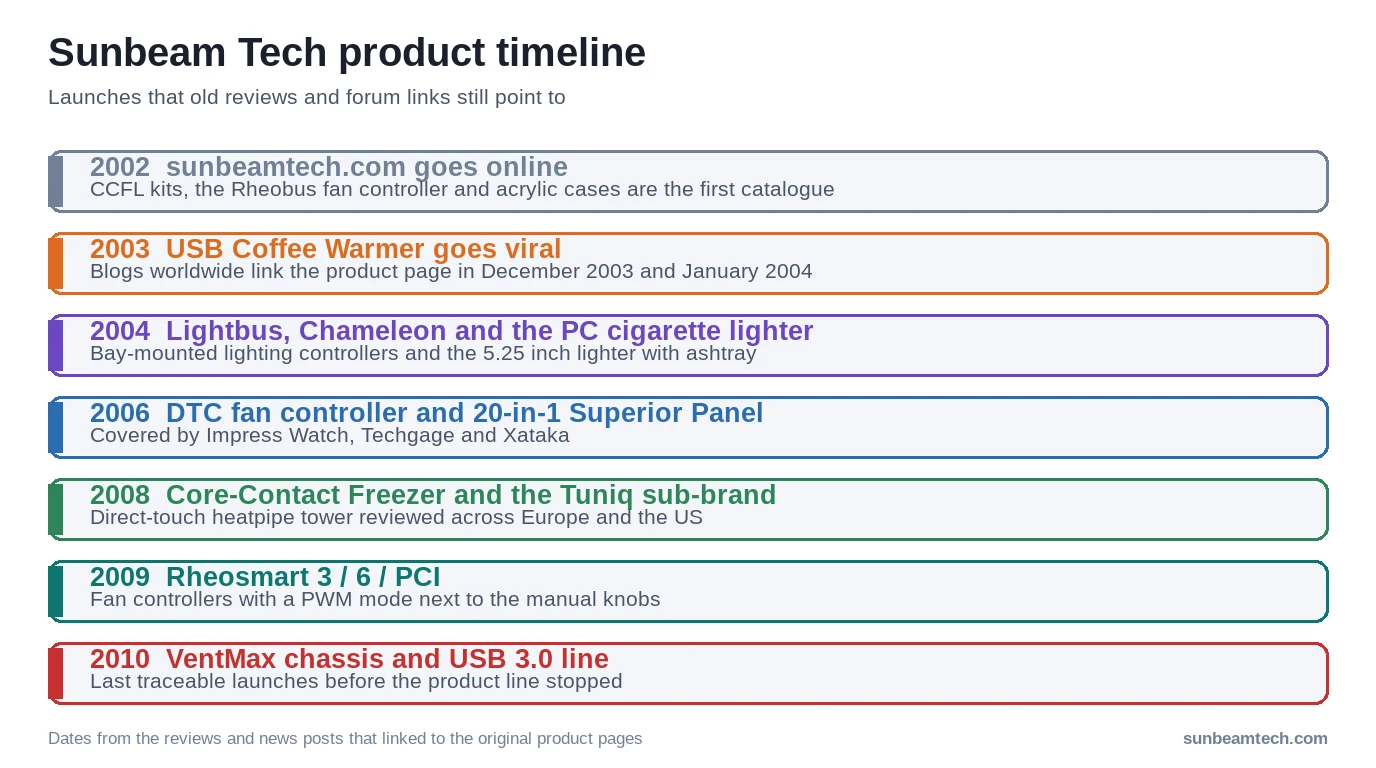
If you landed here from a link written in 2004, 2008 or 2010, the product page you were looking for is gone. Sunbeam Tech stopped launching hardware after its USB 3.0 line and VentMax chassis in 2010, and the original product catalogue was never brought over when this domain became a hardware guide site. Rather than send you to the homepage, we kept the history in one place. Each section below says what the product was, which models the old reviews talk about, and which current guide on this site answers the question you probably had.
Quick lookup: old product to current guide
| Sunbeam Tech product | What it was | Read instead |
|---|---|---|
| Rheobus, Rheobus Extreme, Rheosmart, Theta TP-101, DTC, FC | Bay and PCI fan controllers | PC fan controller and PWM guide |
| Multi Fan Power Port (MFPP) | Fan power hub | Fan hub and splitter guide |
| CCFL kits, Lightbus, Chameleon, Lazer LED, Liquid Neon, Meteor Light, EL wire, LED grills | Case lighting | ARGB vs RGB |
| Chromatic Windmill, Silent UV LED fan, ACUF | Lit case fans | ARGB fans explained |
| Ultra-Tech Station, 9-Bay Acrylic, LED Acrylic Case, Acrylic HTPC | Acrylic cases | Open-air cases and mini-ITX cases |
| Transformer, Samurai, VentMax | Steel mid-towers | How many case fans you need |
| 20-in-1 Superior Panel, 3.5″ Superior Panel, MiniBayBus | Front bay panels | 5.25″ bay devices |
| Wherever PCI Rack, SIUA, Airbox, HDDPAL | Drive mounts and enclosures | How many SSDs a PC can have |
| Core-Contact Freezer, CCTF92, Twister 120, Silent Whisper | CPU coolers | Best budget CPU cooler |
| NUUO 450/550, Silent Storm, ECO750 | Power supplies | Modular vs non-modular PSU |
| PSU Modding Tool Kit, PCI connector packs | Cable modding parts | Cable extensions and sleeving |
| USB 3.0 Expansion Card, USB 3.0 Airbox | USB 3.0 add-ons | USB 2.0 vs 3.0 |
| USB Coffee Warmer, PC Cigarette Lighter | Desk gadgets | No equivalent. See below. |
Fan controllers: Rheobus, Rheosmart, Theta, DTC and the FC
This was Sunbeam Tech’s most reviewed product family. The Rheobus was a 5.25″ bay fan controller with four rotary knobs, each channel with its own wattage ceiling, and it shipped in silver, black and later a UV-reactive version. The Rheobus Extreme bumped the per-channel rating so it could drive high-amperage 120mm fans without cooking the potentiometers. The Rheosmart series (3-channel 3.5″ bay, 6-channel 5.25″ bay, and a single-channel PCI bracket version) added a PWM mode next to the manual mode, which Japanese retailers picked up in 2009. The Theta TP-101 and the DTC-SV/BK (April 2006) were compact bay controllers with temperature readouts, and the FC was a PCI-slot fan controller sold through Newegg.
nn
Original specs. Rheobus: four channels, 20W and up to 1.67A per channel, 0 to 12V output from a 12V Molex input, bi-colour LEDs that switch from red to blue at 7V, 148.5 x 105 x 42mm. Rheobus Extreme (RHK-EX): six channels at 30W per channel, six 3-pin connectors, 148 x 42 x 82mm. Both use rheostats with aluminium heatsinks, which is why the front plate gets warm under load.
What people asked in those forum threads is the same thing people ask now: how many fans can one channel drive, why does a fan hum at low voltage, and whether you need a controller at all when the motherboard has PWM headers. The modern answers are in our PC fan controller and PWM guide and the motherboard fan headers guide. If you were looking for the Multi Fan Power Port (MFPP), the closest current equivalent is a powered hub, covered in the fan hub and splitter guide.
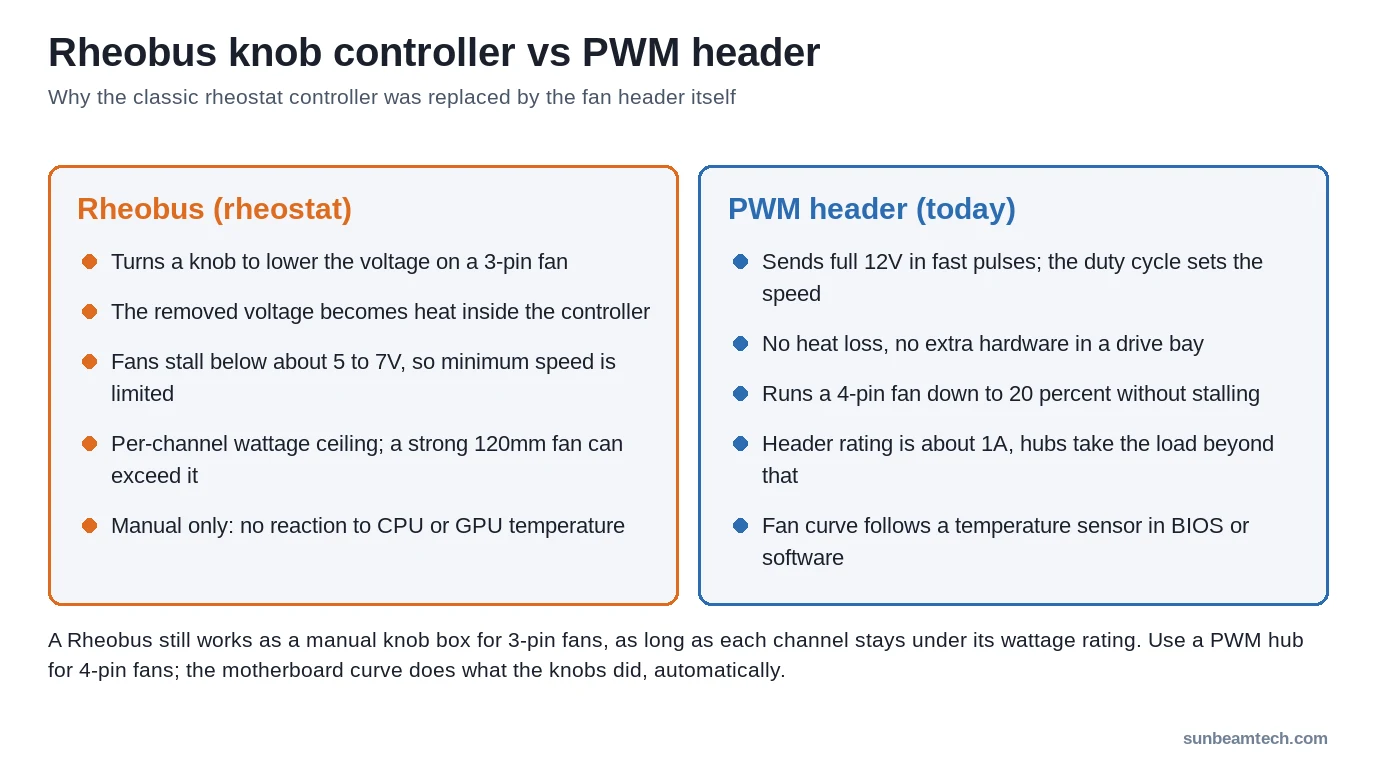
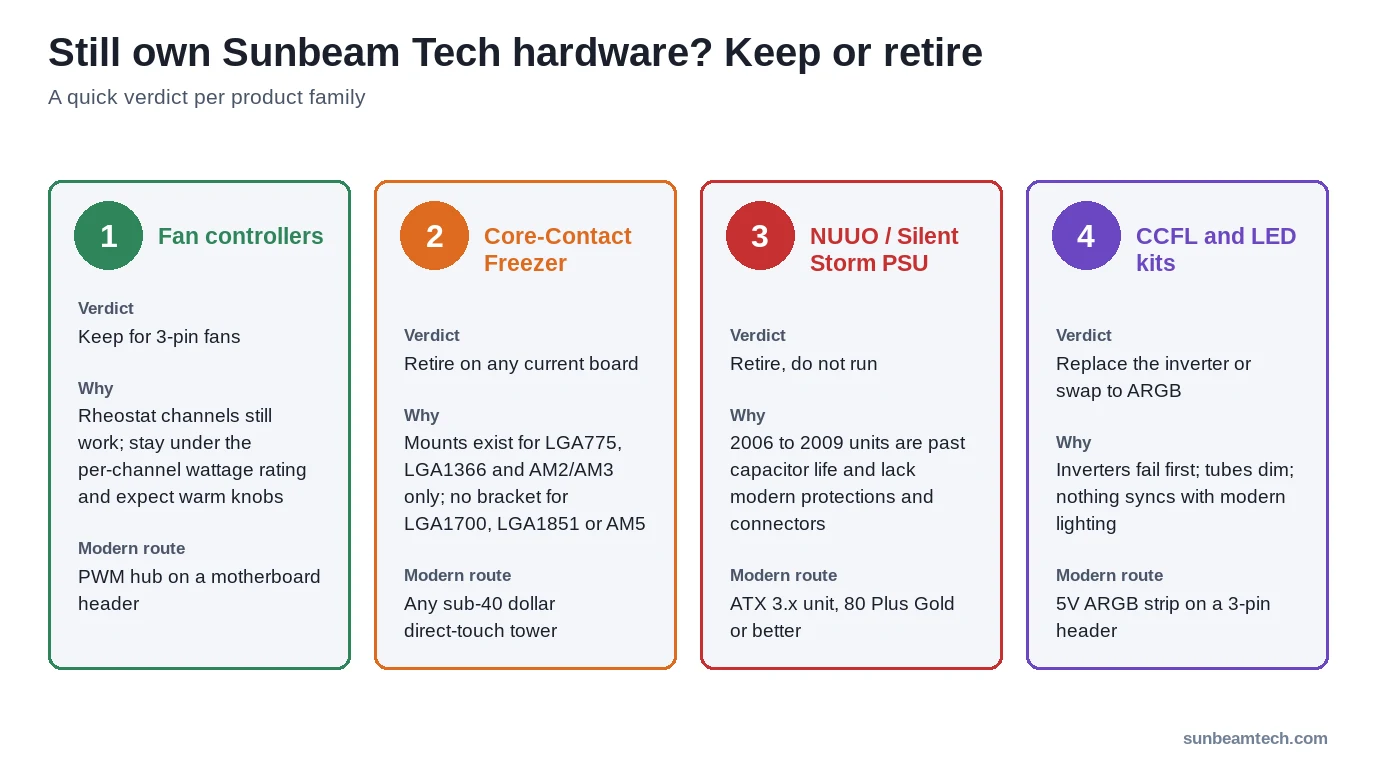
Still own one? A Rheobus or Rheosmart still works as a manual knob box for 3-pin fans. Keep each channel under its printed wattage rating (the knobs run warm by design, hot means you are over it), and expect fans to stall below roughly 5 to 7V. For 4-pin fans, skip it: a PWM hub on one motherboard header gives you a temperature-driven curve for less than the controller is worth on eBay.
Case lighting: CCFL kits, Lightbus, Chameleon, Lazer LED, Liquid Neon
Before addressable RGB existed, case lighting meant cold-cathode fluorescent tubes (CCFL) on a small inverter, and Sunbeam Tech sold more variations of that than anyone: single and dual CCFL kits in every colour, sound-activated inverters, UV tubes, round and 3D fan grills with a CCFL ring built in, Molex-powered LED strings, Lazer LED spot modules, EL wire, Meteor Light and Liquid Neon tubes with switching patterns, and the Lightbus, a 5.25″ bay panel that switched multiple lighting circuits through animated modes. The Chameleon was a colour-cycling controller that arcade-cabinet builders liked. There were also LED case handles and LED case feet.
nn
Original specs. Lightbus (LS-SI silver, LS-BK black): four channels at 0 to 12V from a 12V Molex input, each with an on/off button, a knob for fan speed or CCFL brightness, an HDD-activity mode that flashes with the drive light, a sound mode driven by a mic input (sensitivity around 35dB, adjustable), and two alternating patterns that rotate across the channels. Shipped with a Y-splitter, 3-pin to 2-pin extensions, an audio lead and an HDD indicator lead.
Nothing in that list is worth buying today. CCFL inverters whine, the tubes dim within a couple of years, and a single 5V ARGB header does everything the Lightbus did with less wiring. The current guides are ARGB vs RGB explained, RGB headers on a motherboard and how ARGB fans connect and sync.
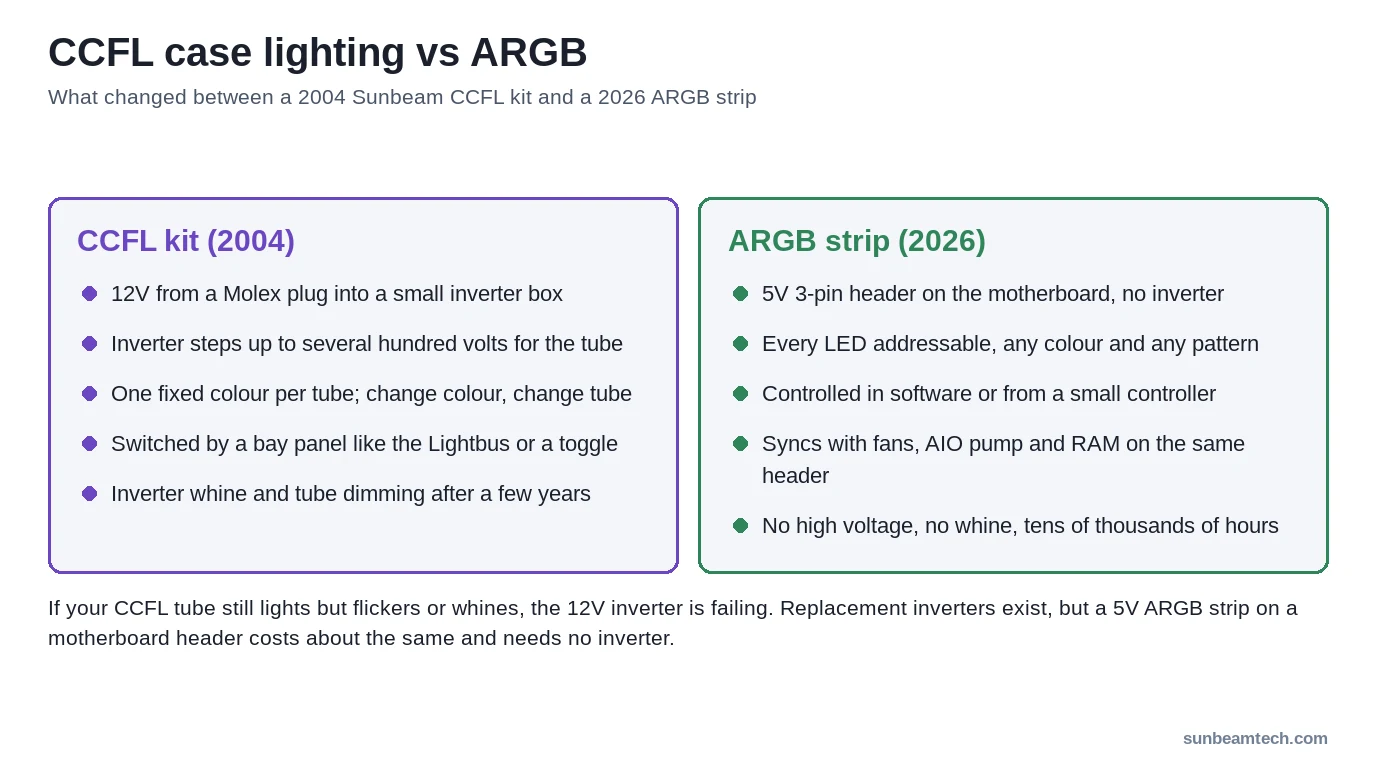
Still own one? A CCFL tube that flickers, buzzes or only lights at one end has a failing inverter, not a failing tube. Generic 12V Molex CCFL inverters are still sold for a few dollars if you want to keep a period-correct build running. The inverter carries several hundred volts on the tube leads, so unplug the PSU before you touch it. For anything else, a 5V ARGB strip on a 3-pin header replaces the whole kit, inverter included.
Cases: acrylic towers, HTPC, Transformer, VentMax, Samurai
Sunbeam Tech’s acrylic cases were the reason a lot of 2003 to 2007 builds looked the way they did. The Ultra-Tech Station and the 9-Bay Acrylic Case were full clear-acrylic towers, the LED Acrylic Case had lighting built into the panels, and the Acrylic HTPC casing was a low, wide desktop version. On the metal side there was the Transformer, a screwless mid-tower (H522 x W205 x D450mm, five exposed 5.25″ bays, eight 3.5″ bays, a windowed side panel with two LED fans and a 10cm CCFL), the Samurai, and the VentMax chassis launched in February 2010 for high-airflow builds. The Lan Party Bag was a padded carry case for the whole rig.
Acrylic cases scratch, crack at the screw holes and turn yellow under UV, which is why nobody makes them any more. If you want the small-footprint look, start with the best mini-ITX and SFF case guide. If you want everything on display, the modern version of a clear case is an open-air case or test bench. For a normal mid-tower, the case fan count guide and airflow diagrams cover the cooling side.
Still own one? Acrylic panels craze around the screw holes and yellow under UV, and the CCFL tubes that came with them are the first thing to fail. If the case is otherwise straight, a modern motherboard still fits (ATX standoff spacing has not changed), but front USB is 2.0 only and there is no place for a 240mm radiator. Treat it as a display piece, not a daily driver. The Transformer and VentMax steel towers are fine to keep using; swap the 80mm LED fans for quieter 120mm units where they fit.
Bay panels and racks: 20-in-1 Superior Panel, Wherever PCI Rack, MiniBayBus
The 20-in-1 Superior Panel (5.25″ bay) and its 3.5″ version packed a card reader, USB and audio ports, a fan controller and temperature display into one front panel. Techgage and Xataka both covered it in 2006. The Wherever PCI Rack was a bracket that mounted a 2.5″ drive or an extra device in a spare PCI slot, and it still gets linked from sysadmin threads as an answer to “how do I mount a drive where there is no bay”. The MiniBayBus was a smaller fan and light control panel.
Front-panel card readers died with the SD card slot on laptops, but the bay device category is alive. See 5.25″ bay devices and multi-function panels. For the drive-mounting question, how many SSDs a PC can have covers M.2 slots, SATA and the adapters that replaced PCI racks.
CPU coolers: Core-Contact Freezer, Twister 120, Silent Whisper, CCTF92
The Core-Contact Freezer (2008) was Sunbeam Tech’s one mainstream hit: a tower cooler with four exposed heatpipes making direct contact with the CPU, a 120mm fan, and a price well under the Noctua and Thermalright towers it was benchmarked against. Futurelooks, ModSynergy, Techzine, Hartware and Noticias3D all reviewed it, and a Socket 1366 adapter followed for the first Core i7 boards. The CCTF92 was the 92mm version. Earlier coolers were the Twister 120 and the Silent Whisper, and there was a copper SODIMM heat spreader for laptop memory. The Tuniq sub-brand (Tuniq Tower 120) ran alongside these from 2008.
nn
Original specs. Core-Contact Freezer 120mm: four 8mm U-shaped heatpipes in direct contact with the CPU, bent-fin stack, 590g without the fan, a 120mm magnetic fluid dynamic bearing fan rated at 16dBA and 50,000 hours with a bundled speed controller, and a tube of TX-2 thermal paste in the box. Retention bracket sets were sold separately for LGA1366 (Core i7) and LGA1156 (Core i5).
Direct-contact heatpipes are now standard on every budget tower, which makes the Core-Contact Freezer’s successors the whole sub-$40 category. Our best budget CPU cooler guide is the current version of that review, and how to install a CPU cooler and apply paste covers the mounting part the old reviews always complained about.
Still own one? The Core-Contact Freezer only mounts on LGA775, AM2/AM3 and, with the separately sold bracket sets, LGA1366 and LGA1156. No bracket was ever made for LGA1150 and later or for AM4/AM5, and the bolt pattern does not line up, so it cannot be adapted. On a board it fits, it is still a competent cooler; repaste it, since the original paste is 15 years old. Everything else in this family is retired.
Power supplies: NUUO, Silent Storm, ECO750, PSU modding kit
The NUUO 450W and 550W were modular units that picked up NVIDIA SLI certification, the Silent Storm was a quiet fixed-cable design, and the PSU-ECO750-US-BL was a 750W unit sold through Newegg Canada. The PSU Modding Tool Kit was a set of pin extractors and sleeving for people who rewired their own cables, and the PCI connector packs were bare ATX connectors sold to the same crowd.
Current guides: modular vs non-modular PSU, PSU cables explained, cable extensions and sleeving kits, and how to check which power supply you have.
Still own one? Do not put a 2006 to 2009 NUUO, Silent Storm or ECO750 into a current build. The electrolytic capacitors are past their rated life, there is no 12VHPWR or 12V-2×6 connector, and the over-current protection predates modern GPU transient spikes. Recycle it. The modding tool kit is the exception: pin extractors do not age, and they still fit ATX terminals.
USB gadgets: the coffee warmer, the PC cigarette lighter, USB 3.0 cards
In December 2003 a photo of the Sunbeam Tech USB Coffee Warmer went round the early blogosphere, complete with the company’s own chart showing cup temperature with and without the warmer. It was a heating plate on a USB cable, it drew a fraction of what a real hotplate needs, and it became the standard example of “things USB should not be used for”. The 5.25″ bay cigarette lighter with ashtray got the same treatment a year later. Later and more useful were the SIUA (a SATA/IDE to USB adapter for plugging in a bare drive), the Airbox and HDDPAL external enclosures, and a USB 3.0 expansion card and enclosure line launched in 2010.
The USB 3.0 questions those launches raised are answered in USB 2.0 vs 3.0 differences and USB 2.0, 3.0 and 3.2 headers. If your external drive is not showing up, that has its own troubleshooting guide. The coffee warmer has no modern equivalent, and that is fine.
About this page
This site is not affiliated with the original Sunbeam Tech company and does not sell or support its products. We keep this page because thousands of forum posts, reviews and blog entries from 2002 to 2012 still link to the old product catalogue, and a working page with accurate context beats a dead link. Product details above come from the archived product pages and the reviews that linked to them. The original site is preserved in the Internet Archive: sunbeamtech.com in 2004, 2008 and 2010, including most product pages with their spec tables (for example the Transformer spec sheet). If you own one of these products and have a manual or spec sheet we have not captured, send it over and we will add it.
Looking for something current instead? Start with Hardware Guides, Cooling or PC Building.